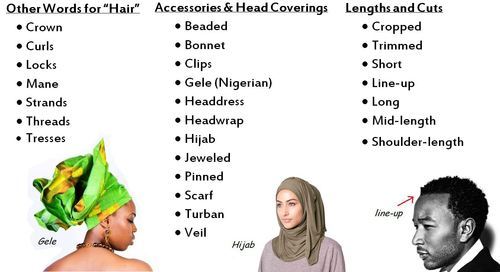
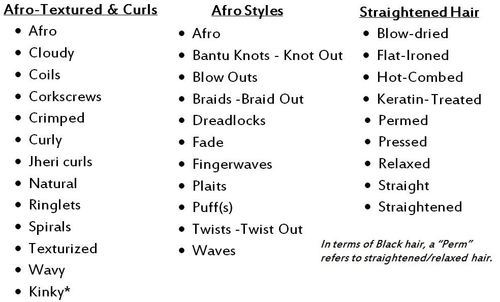
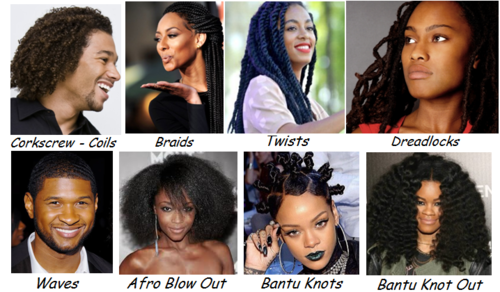
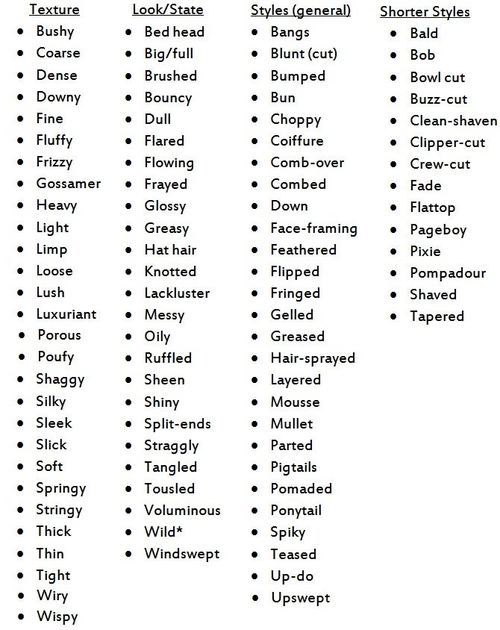
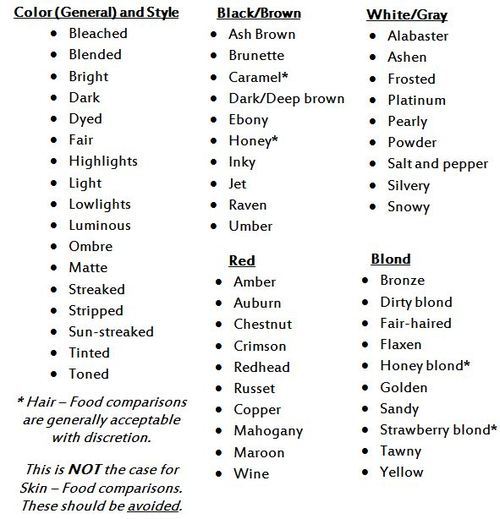
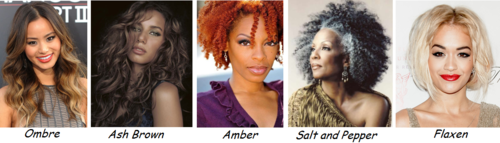
This began as a guide to describing Afro/curly hair but of course, I got carried away. From look and texture of hair, colors and various styles, this guide serves as a thesaurus of sorts for hair, as well as pointers for use in your writing.
Culturally Significant Hair Coverings:
Know the meaning behind head wear and why it’s worn, when and by whom, such as a Native Nation’s headdress, before bestowing a character with it.
Appropriative Hairstyles: Keep in mind that Afro styles should be kept to those in the African Diaspora, such as dreadlocks, cornrows + certain and many braided styles.
Tread carefully describing Afro hair as “wild” “unkempt” “untamed” or any words implying it’s unclean or requires controlling.
“Nappy” and “wooly” are generally words to stay away from, the first having heavy negative connotations for many and the latter, though used in the Holy Bible, is generally not acceptable anymore and comes off as dehumanizing due to Animal connotations.
There are mixed feelings on calling Black hair “kinky.” I’m personally not opposed to the word initself and usage depends on the person’s race (I’m more comfortable with a Black person using it vs. a Non-Black person) as well as their tone and context (if it’s used in a neutral or positive tone vs. negatively/with disdain). Get feedback on your usage, or simply forgo it.
Combination Words: Try combing words to illustrate look of hair. A character with springy coils that dance across her shoulders with every movement, the man with thick silvery hair slicked back into a ponytail…
Mind Perspective: Depending on POV, a character might not know exactly what cornrows or a coiffure style is, at least in name, and it might make more sense if they described the hairdo instead. More defining terms might come from a more knowing source or the wearer themselves. One book I read described a girl’s afro puff as “thick hair pulled up into a cute, curly, poufy thing on top of her head and tied with a yellow ribbon.”
POC & Hair Colors: People of Color’s hair comes in all shades and textures. There are Black people with naturally blond and loosely-textured to straight hair, East Asian people with red hair, and so on. Keep that in mind when coding characters if you tend to rely on hair color alone to denote a character is white vs. a Person of Color.
Related Tropes: There are tropes and discussion related to People of Color, colored hair, and light-colored hair and features.
We’re making some overdue improvements to the code that powers our login system. When we make these changes, all Archive users will be logged out of their accounts.
To avoid permanently losing access to your account, please make sure you know your password and/or can receive password reset emails by December 13.
If you don’t have access to your email address, please contact Policy & Abuse immediately.
We’ll do our best to help you regain access to your account whenever you contact us, but it’ll be a much easier process if it’s done while you’re still logged in. If you wait to get in touch with us later and can’t prove account ownership, we won’t be able to update your email and you might be logged out permanently.
Please take a moment to check your email account, and send a ticket as soon as you can if you need to have your email address manually updated. You can always reach Policy & Abuse here:
i will legit never understand how ppl r always like “awwwww i wish i could support my fav artist” and then literally never reblog or retweet the art they like
I just want you guys to know that the woman of the confused lady meme is a Brazilian actress
it’s a scene from a soap opera. her character was called Nazaré Tedesco. This was one of the most iconic roles in all of Brazilian soap operas. So here goes another iconic scene (it’s Nazaré kidnapping a baby) that you guys can use to make memes:
I’m so glad this post is still going around
wtf this entire time i thought she was the tall lady from american horror story
The way that we learn about Helen Keller in school is an absolute outrage. We read “The Miracle Worker”- the miracle worker referring to her teacher; she’s not even the title character in her own story. The narrative about disabled people that we are comfortable with follows this format- “overcoming” disability. Disabled people as children.
Helen Keller as an adult, though? She was a radical socialist, a fierce disability advocate, and a suffragette. There’s no reason she should not be considered a feminist icon, btw, and the fact that she isn’t is pure ableism- while other white feminists of that time were blatent racists, she was speaking out against Woodrew Wilson because of his vehement racism. She supported woman’s suffrage and birth control. She was an anti-war speaker. She was an initial donor to the NAACP. She spoke out about the causes of blindness- often disease caused by poverty and poor working conditions. She was so brave and outspoken that the FBI had a file on her because of all the trouble she caused.
Yet when we talk about her, it’s either the boring, inspiration porn story of her as a child and her heroic teacher, or as the punchline of ableist, misogynistic jokes. It’s not just offensive, it’s downright disgusting.
the reason the story stops once hellen keller learns to talk is no one wanted to listen to what she had to say
how’s that for a fucking punchline
Another part of the story that is often conveniently omitted is that Anne Sullivan, the “miracle worker” in question, was also a visually impaired woman (and abolitionist) who faced her own struggles finding accessible education. That was why she was able to teach Helen Keller and connect her with resources that would allow her to flourish in academia. When Helen Keller was railing against poverty-induced diseases that caused blindness, she was talking about things like trachoma which was what had caused her friend’s vision loss.
The fact that Sullivan is often portrayed as able-bodied in retellings of their story is indicative of the narrative that is most comfortable for an ableist society: that accessibility and equality are gifts bestowed upon the disabled by able-bodied heroes. Disabled children are never taught that they have the power to lift eachother up, and that’s a crying shame.

















 Anxiety-prone-human